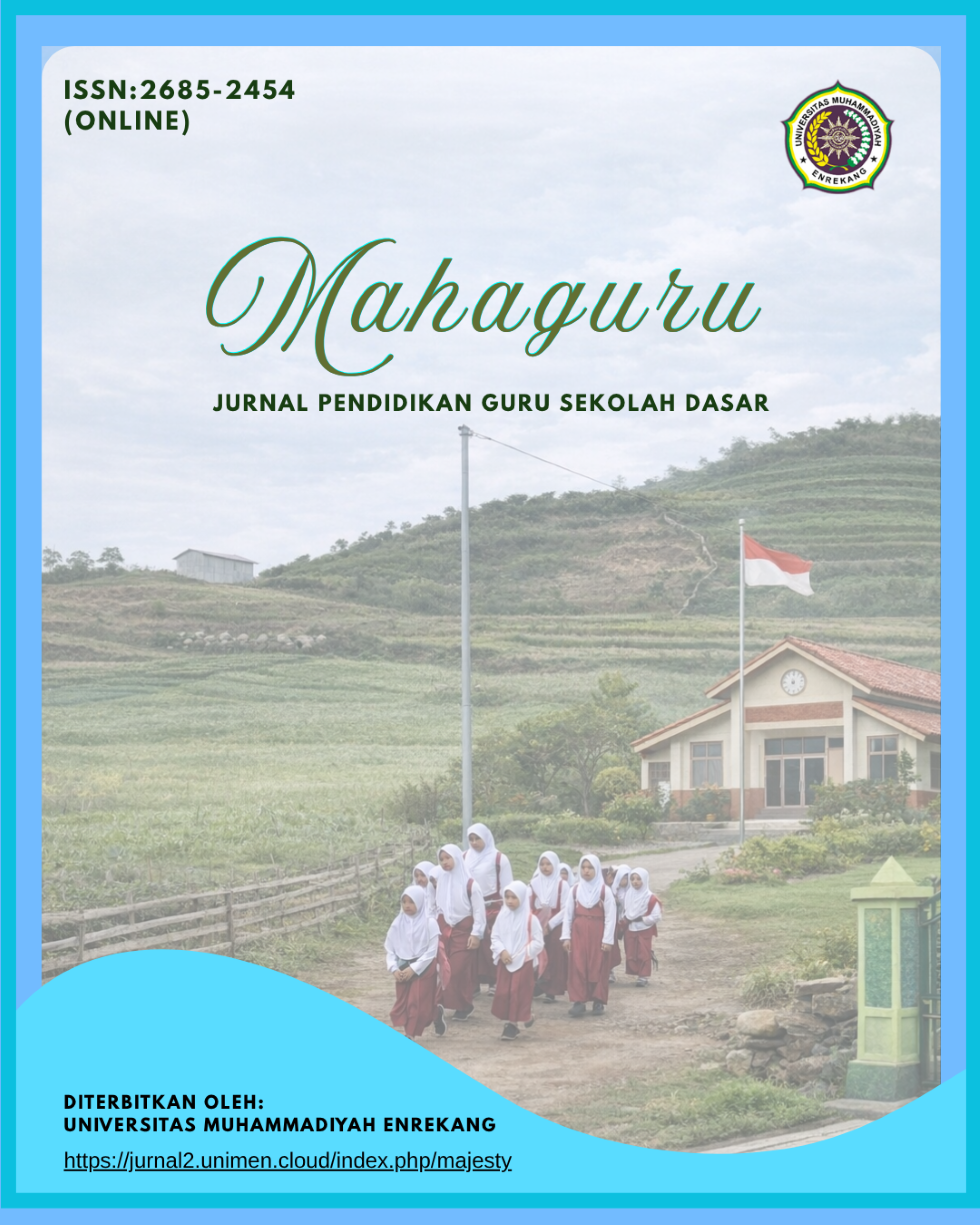
Author Guidelines
Author Guidelines
Mahaguru: Jurnal Pendidikan Guru Sekolah Dasar
Guidelines for Manuscript Preparation
These author guidelines are prepared to assist authors in writing, formatting, and submitting manuscripts to Mahaguru: Jurnal Pendidikan Guru Sekolah Dasar. Authors are expected to follow these guidelines carefully to ensure that submitted manuscripts meet the journal’s academic, technical, ethical, and formatting standards.
The journal welcomes scholarly manuscripts that contribute to the development of elementary school teacher education, primary education, classroom-based research, curriculum innovation, literacy and numeracy, learning media, assessment, inclusive education, character education, local wisdom, educational technology, and professional development of elementary school teachers.
Journal Field
Elementary school teacher education and primary education studies.
Publication Language
Manuscripts may be prepared in Indonesian or English using academic language.
Review Process
All submitted manuscripts are subject to editorial screening and peer review.
Guideline Sections
1. Focus and Scope of Manuscripts
Manuscripts submitted to Mahaguru: Jurnal Pendidikan Guru Sekolah Dasar must be relevant to the advancement of elementary school teacher education and primary education. Manuscripts should present clear academic contribution, educational relevance, methodological quality, and implications for theory, policy, or classroom practice.
Relevant topics include, but are not limited to:
- Elementary school curriculum, learning design, and instructional innovation.
- Literacy, numeracy, science, social studies, mathematics, citizenship, language, arts, culture, religion, sports, and environmental education in primary schools.
- Learning models, approaches, methods, strategies, and classroom management.
- Learning media, digital learning tools, educational technology, and teaching materials for elementary education.
- Assessment, evaluation, learning outcomes, classroom action research, and school-based improvement.
- Teacher education, teacher professionalism, pedagogical competence, and professional development of elementary school teachers.
- Inclusive education, character education, local wisdom, rural education, and contextual pedagogy.
2. Types of Manuscripts
The journal accepts manuscripts that are original, scholarly, and relevant to elementary school teacher education. Authors should select the manuscript type that best represents the purpose, method, and contribution of the study.
Research Article
Reports empirical research, classroom action research, experimental studies, survey studies, qualitative studies, mixed-method research, or development research.
Conceptual Paper
Presents theoretical analysis, conceptual frameworks, critical reflection, or scholarly arguments related to elementary education.
Best Practice Study
Describes innovative teaching practices, school-based programs, learning media implementation, or classroom improvement initiatives.
3. General Manuscript Format
| File Format | Microsoft Word document format or another editable format accepted by the journal system. |
| Paper Size | A4 paper size, following the journal template when available. |
| Length | Manuscripts should be concise, complete, and proportional to the type of article. Authors should follow the official journal template if page limits are specified. |
| Language | Indonesian or English. The manuscript must use clear, formal, academic, and grammatically correct language. |
| Template | Authors are strongly encouraged to use the official manuscript template provided by the journal. |
4. Manuscript Structure
A research article submitted to Mahaguru should generally contain the following components. Adjustments may be made according to manuscript type, research design, and journal template requirements.
- Title
- Author name(s), affiliation(s), and corresponding author information
- Abstract
- Keywords
- Introduction
- Method
- Results and Discussion
- Conclusion
- Acknowledgments, funding information, or conflict of interest statement when applicable
- References
- Appendices or supplementary materials when necessary
5. Title
The title must be concise, informative, specific, and accurately reflect the main focus of the manuscript. It should indicate the topic, educational level, variables or concepts, and research context when necessary.
- The title should avoid unnecessary words, abbreviations, and overly broad statements.
- The title should represent the core contribution of the study.
- For classroom-based research, the title may include learning model, subject area, grade level, or school context when relevant.
- For development research, the title may indicate the product, media, module, or learning tool being developed.
6. Author Identity and Affiliation
Authors must provide accurate identity and institutional information. Authorship should reflect substantial scholarly contribution to the manuscript.
- Write the full name of each author without academic titles unless the template requires otherwise.
- Provide complete institutional affiliation, including department or study program, institution name, city, and country.
- Provide the corresponding author’s active email address.
- Authors are encouraged to include ORCID ID when available.
- Author order must be agreed upon by all authors before submission.
- Changes in authorship after submission must be justified and approved by all authors and the editorial team.
7. Abstract and Keywords
The abstract must provide a brief but complete summary of the manuscript. It should allow readers to understand the purpose, method, findings, and contribution of the study without reading the full article.
Abstract Content
The abstract should include research background, objective, method, main findings, and conclusion or contribution.
Keywords
Provide 3–6 keywords that represent the core concepts of the manuscript, such as literacy, numeracy, learning media, classroom action research, primary education, or teacher competence.
8. Introduction
The introduction should present the research background, problem statement, urgency, research gap, novelty, and objectives. Authors should clearly explain why the study is important for elementary education and how it contributes to knowledge or practice.
- Begin with the broader educational issue or context.
- Explain the specific problem in elementary education, teacher education, or classroom practice.
- Review relevant previous studies briefly and critically.
- Identify the gap or limitation in previous research.
- State the objective, research question, or hypothesis clearly.
- Explain the novelty and expected contribution of the study.
9. Method
The method section must describe the research design and procedures clearly enough for readers to evaluate the validity and reliability of the study. The method should be appropriate to the research problem and objectives.
The method section may include:
- Research design or approach.
- Research setting and context.
- Participants, subjects, population, sample, or informants.
- Data collection techniques and instruments.
- Procedure of implementation, intervention, or classroom action.
- Data analysis techniques.
- Validity, reliability, triangulation, or trustworthiness strategies.
- Ethical considerations, informed consent, and institutional permission when applicable.
10. Results
The results section should present research findings clearly, accurately, and systematically. Results may be presented in narrative form, tables, figures, charts, classroom excerpts, observation summaries, or statistical analysis according to the research design.
- Present only findings that are relevant to the research objectives.
- Avoid repeating all data from tables or figures in the text.
- Use clear labels for tables, figures, and diagrams.
- For classroom action research, explain each cycle or stage clearly.
- For development research, present validation results, practicality, effectiveness, and product revision when relevant.
- For qualitative studies, provide evidence such as themes, categories, quotations, or field notes responsibly.
11. Discussion
The discussion section should interpret the findings, relate them to previous research, explain their significance, and describe their implications for elementary education or teacher education.
- Explain what the findings mean, not merely restate the results.
- Compare findings with relevant previous studies or theories.
- Discuss implications for classroom practice, teacher education, curriculum, learning media, assessment, or education policy.
- Explain possible reasons behind the findings.
- State the limitations of the study honestly.
- Recommend future research directions when appropriate.
12. Conclusion
The conclusion should provide a concise answer to the research objective or research question. It should summarize the most important findings and clarify the contribution of the manuscript.
- Do not introduce new data or new references in the conclusion.
- State the main contribution of the study.
- Describe practical implications for elementary education when relevant.
- Provide recommendations that are supported by the findings.
- Avoid overly broad claims that exceed the evidence presented.
13. Tables, Figures, Images, and Learning Media Documentation
Tables, figures, diagrams, images, and documentation must support the explanation of the manuscript and must be presented clearly. Authors should ensure that all visual materials are original, properly cited, or used with permission.
- Tables and figures must be numbered sequentially.
- Each table and figure must have a clear title or caption.
- Images must have sufficient quality for publication.
- Student photographs, classroom images, and school documentation must be used ethically and with permission when required.
- Data in tables and figures must match the explanation in the text.
- Do not use decorative images that do not support the manuscript content.
14. Citation and References
References must be accurate, relevant, and complete. Authors should prioritize recent and reputable academic sources, such as journal articles, books, conference proceedings, official policy documents, and credible educational reports.
Recommendation: Authors are encouraged to use reference management tools such as Mendeley, Zotero, or EndNote to ensure consistency in citation and reference formatting.
- Every source cited in the text must appear in the reference list.
- Every source in the reference list must be cited in the manuscript.
- Use recent sources where appropriate, especially for current educational issues.
- Avoid excessive citation of non-academic or unreliable sources.
- Ensure that DOI or URL information is accurate when available.
- Follow the reference style required by the journal template.
15. Research Ethics and Participant Protection
Authors must comply with ethical principles when conducting research involving pupils, teachers, principals, parents, schools, communities, or educational institutions. Special care must be taken when research involves children and classroom settings.
- Participation must be voluntary and based on informed consent when required.
- Research involving children must protect safety, dignity, privacy, and psychological well-being.
- Authors must obtain school or institutional permission when necessary.
- Student identities, photographs, and personal information must be protected.
- Educational data, assessment results, classroom observations, and interview transcripts must be reported responsibly.
- Research must not stigmatize pupils, teachers, families, schools, communities, or geographic areas.
16. Use of Generative AI and AI-Assisted Tools
Authors must disclose substantive use of generative AI or AI-assisted tools in manuscript preparation, data analysis, translation, summarization, proofreading, or content generation when such tools significantly affect the manuscript.
- AI tools cannot be listed as authors or co-authors.
- Authors remain fully responsible for the accuracy, originality, validity, and ethical compliance of the manuscript.
- AI tools must not be used to fabricate data, generate false references, manipulate images, or misrepresent findings.
- AI-assisted content must be reviewed, verified, edited, and approved by the authors.
- Confidential data, student information, school records, and unpublished manuscripts should not be uploaded to public AI systems without proper safeguards.
Suggested declaration:
During the preparation of this manuscript, the author(s) used [name of tool/service] for [specific purpose]. After using this tool or service, the author(s) reviewed, edited, verified, and approved the content and take full responsibility for the final version of the manuscript.
17. Online Submission Procedure
Manuscripts must be submitted through the official online journal system. Authors must register or log in to the journal website before submitting a manuscript.
- Register or log in to the journal website.
- Read the author guidelines and prepare the manuscript according to the journal template.
- Complete manuscript metadata, including title, abstract, keywords, author information, and references.
- Upload the manuscript file and supplementary files when needed.
- Confirm that the manuscript is original and not under consideration elsewhere.
- Submit the manuscript and monitor the editorial process through the online system.
18. Final Submission Checklist
Before submitting a manuscript to Mahaguru, authors should ensure that all required components have been prepared properly.
Manuscript Readiness
- The manuscript follows the journal template.
- The title, abstract, and keywords are complete.
- The structure is clear and complete.
- Tables and figures are properly labeled.
Academic Quality
- The research problem and objective are clear.
- The method is appropriate and transparent.
- The discussion is supported by findings and references.
- The conclusion is consistent with the results.
Ethical Compliance
- The manuscript is original and free from plagiarism.
- All sources are properly cited.
- Permissions and consent are obtained when required.
- AI use is disclosed when relevant.
Manuscripts that do not follow the journal’s author guidelines may be returned to authors for correction before being considered for peer review.