ISSN
ISSN Online
2716-4446
Journal DOI Prefix
10.33487
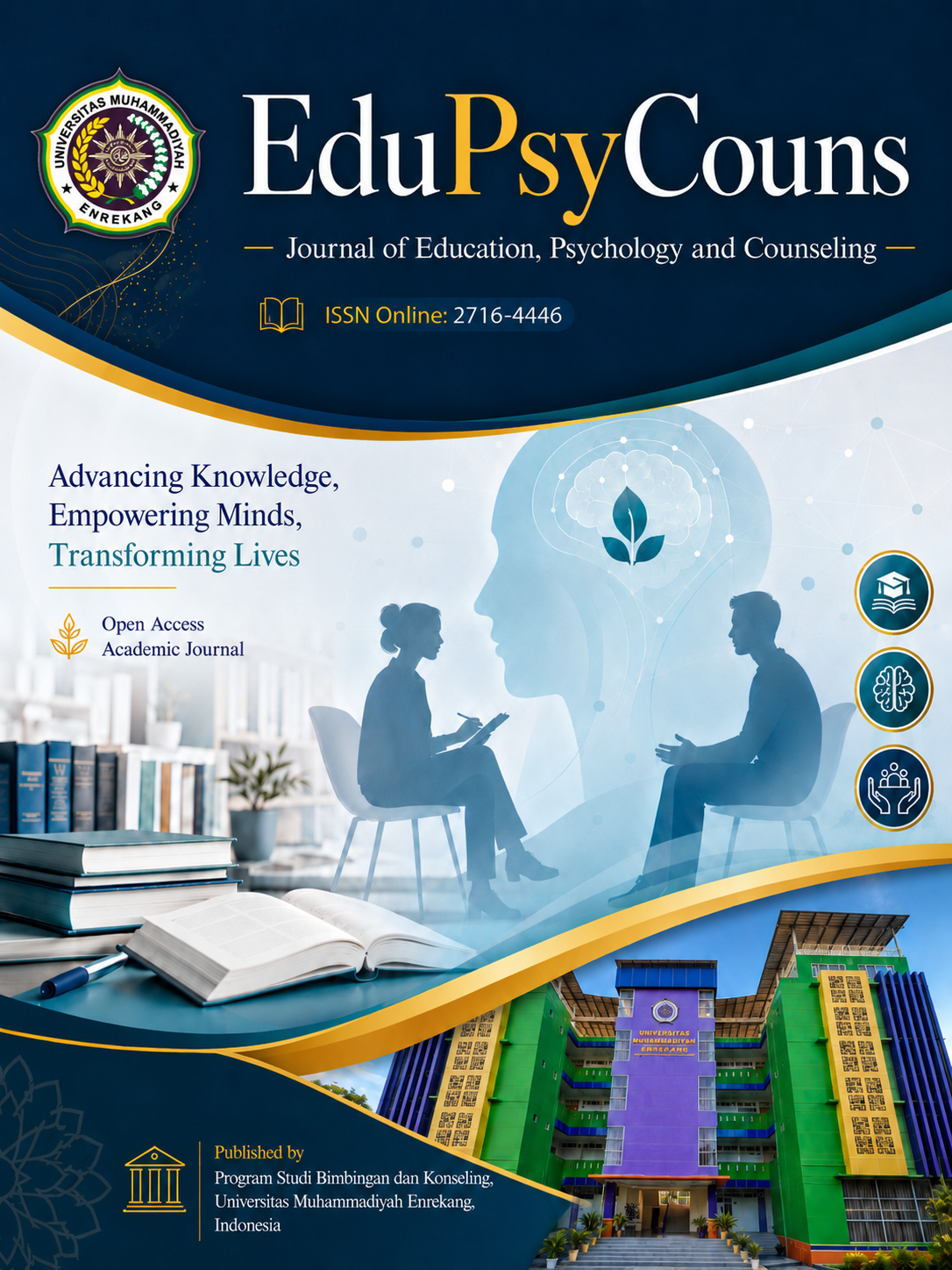
Guidelines for manuscript preparation, submission, review, and publication
EduPsyCouns: Journal of Education, Psychology and Counseling publishes scholarly works in education, psychology, guidance and counseling, psychological counseling, personal guidance, academic guidance, social guidance, career counseling, family counseling, spiritual counseling, multicultural issues in counseling, educational psychology, and related interdisciplinary studies. Authors are required to prepare manuscripts according to these guidelines before submission through the journal’s online submission system.
Manuscripts submitted to EduPsyCouns must be original, unpublished, and not under consideration for publication in another journal, proceeding, book chapter, or academic platform. The manuscript must contribute to the development of knowledge, practice, policy, or innovation in the fields of education, psychology, guidance, and counseling.
Authors must ensure that the manuscript is aligned with the journal’s focus and scope, follows academic writing standards, uses proper citation practices, and has been carefully checked for clarity, coherence, grammar, formatting, and ethical compliance.
All manuscripts should be submitted through the official online submission system of the journal. Authors are encouraged to use the official manuscript template to ensure consistency in structure, citation style, tables, figures, and references.
EduPsyCouns accepts the following categories of scholarly manuscripts:
Manuscripts may be written in English or Bahasa Indonesia. Authors who submit manuscripts in English should ensure that the language is formal, academic, clear, and grammatically accurate. Manuscripts written in Bahasa Indonesia should use standard academic Indonesian and should avoid informal wording.
Regardless of the manuscript language, the abstract should be presented clearly and should reflect the main purpose, method, findings, and contribution of the study.
The manuscript should be organized systematically using the following structure:
| Title | Concise, specific, informative, and reflecting the main topic of the manuscript. |
| Author Identity | Author name, institutional affiliation, email address, and corresponding author information. |
| Abstract | Contains the background, objective, method, key findings, and conclusion. |
| Keywords | Three to five keywords, arranged alphabetically where possible. |
| Introduction | Explains background, research gap, novelty, problem statement, and research objective. |
| Method | Explains design, participants, instruments, data collection, and data analysis. |
| Results and Discussion | Presents findings, interpretation, comparison with previous studies, and implications. |
| Conclusion | Summarizes major findings, contribution, limitations, and suggestions. |
| References | Contains only sources cited in the manuscript and follows APA 7th edition. |
The abstract should be written in one paragraph and should not exceed 200–250 words. It should provide a clear summary of the manuscript, including the research background, purpose, method, major findings, and conclusion.
The abstract should not contain citations, tables, figures, abbreviations that are not explained, or overly general statements. It must be written clearly so that readers can understand the essence of the study without reading the full manuscript.
Keywords should consist of three to five terms that represent the main concepts of the article, such as education, psychology, counseling, guidance, school counseling, career counseling, social-emotional learning, multicultural counseling, or educational psychology.
The introduction should present the background of the study, current scholarly debate, empirical or theoretical gaps, urgency of the topic, and the novelty of the research. Authors should avoid writing an introduction that is too broad or unrelated to the research problem.
A strong introduction should contain a logical flow from general context to specific research focus. It should include relevant recent literature, demonstrate the significance of the issue, and clearly state the research problem.
The final part of the introduction should explicitly state the objective of the study, research questions or hypotheses where applicable, and the expected contribution of the article.
The method section should provide sufficient detail to allow readers to understand how the study was conducted and how the findings were obtained. The method should be consistent with the research objectives and the type of study.
For empirical research, this section should include:
For conceptual or review articles, authors should explain the selection of literature, analytical framework, inclusion and exclusion criteria, and the basis for argument development.
The results section should present findings clearly, systematically, and objectively. Findings may be supported by tables, figures, excerpts, statistical results, categories, themes, or descriptive explanations, depending on the research method.
The discussion should interpret the findings, explain their meaning, compare them with previous studies, and highlight their theoretical, practical, or policy implications. Authors should avoid merely repeating the results without analysis.
A strong discussion should demonstrate the originality of the study, its contribution to education, psychology, guidance, or counseling, and its relevance for researchers, teachers, counselors, school leaders, policymakers, or community practitioners.
The conclusion should present the main findings of the study in a concise and meaningful way. It should not simply repeat the abstract or results but should synthesize the contribution of the article.
Authors are encouraged to include practical implications, limitations of the study, and recommendations for future research or practice in education, psychology, guidance, or counseling.
| File Format | Microsoft Word format (.doc or .docx) |
| Paper Size | A4 |
| Font | Times New Roman or the official journal template font |
| Main Text Size | 11 or 12 pt, according to the journal template |
| Spacing | Single or 1.15 spacing, following the journal template |
| Layout | Single column or journal template layout |
EduPsyCouns uses the APA Style, 7th edition for in-text citations and references. Authors must ensure that every citation in the manuscript appears in the reference list and that every reference in the list is cited in the manuscript.
Authors are strongly encouraged to use reference management tools such as Mendeley, Zotero, EndNote, or similar applications to maintain citation accuracy and consistency.
Example of journal article reference:
Author, A. A., & Author, B. B. (Year). Title of article. Title of Journal, volume(issue), page–page. https://doi.org/xxxxx
Authors must comply with academic publication ethics. The manuscript must be free from plagiarism, data fabrication, data falsification, duplicate submission, inappropriate authorship, citation manipulation, and unethical research practices.
Research involving human participants, students, counseling clients, schools, families, or communities should respect informed consent, confidentiality, voluntary participation, privacy, and ethical responsibility.
Authors are responsible for obtaining necessary permissions when using copyrighted materials, research instruments, images, or data owned by other parties.
All manuscripts submitted to EduPsyCouns may be screened using plagiarism detection software. Manuscripts with excessive similarity, improper citation, or indication of plagiarism may be returned to authors, rejected, or subjected to further editorial evaluation.
Authors should ensure that quoted, paraphrased, or adapted ideas from other sources are properly cited according to APA Style. Self-plagiarism and redundant publication should also be avoided.
Manuscripts submitted to EduPsyCouns are evaluated through an editorial screening and peer review process. The editorial team first checks the manuscript’s suitability with the journal’s focus and scope, formatting requirements, originality, and ethical compliance.
Manuscripts that pass the initial screening will be reviewed by qualified reviewers. Reviewers provide recommendations regarding the quality, originality, methodological rigor, clarity, relevance, and contribution of the manuscript.
Possible editorial decisions include accepted, revision required, resubmit for review, or rejected. Authors must revise their manuscripts according to reviewer and editor comments within the specified period.
Authors receiving revision decisions must revise the manuscript carefully and provide a response to reviewer comments where required. Revisions should be made clearly and systematically.
Before final publication, accepted manuscripts may undergo copyediting, layout editing, and proofreading. Authors are responsible for checking the accuracy of names, affiliations, tables, figures, citations, and references during the proofreading stage.
Authors retain the copyright of their work while granting the journal the right of first publication. Articles published in EduPsyCouns are distributed under an open access policy.
Published articles may be read, downloaded, copied, distributed, printed, searched, cited, and used for academic and educational purposes with proper acknowledgment of the original source.
License: This work is licensed under a Creative Commons Attribution 4.0 International License.
Where applicable, authors should include the following declarations before the reference list:
Authors may use AI-assisted tools only to support language editing, grammar checking, translation assistance, or formatting improvement. AI tools must not replace the intellectual contribution, critical analysis, data interpretation, or scholarly responsibility of the authors.
If AI tools are used in preparing the manuscript, authors must disclose their use in a declaration statement. Authors remain fully responsible for the accuracy, originality, validity, and ethical integrity of the manuscript.
Suggested declaration: During the preparation of this manuscript, the author(s) used [name of tool] for [purpose]. After using this tool, the author(s) reviewed, revised, and approved the content and take full responsibility for the final manuscript.
Before submitting a manuscript, authors should ensure that:
| Journal Title | EduPsyCouns: Journal of Education, Psychology and Counseling |
| ISSN Online | 2716-4446 |
| DOI Prefix | 10.33487 |
| Publication Frequency | Twice a year, June and December |
| Publisher | Program Studi Bimbingan dan Konseling, Universitas Muhammadiyah Enrekang |
| Access Policy | Open Access |
ISSN Online
Journal DOI Prefix
10.33487


EduPsyCouns: Journal of Education, Psychology and CounselingOpen Access journal in education, psychology, guidance, counseling, and educational counseling practices, published by Program Studi Bimbingan dan Konseling, Universitas Muhammadiyah Enrekang. |
JOURNAL INFORMATION ISSN Online: 2716-4446 |
ABOUT JOURNAL |
AUTHOR MENUMake a Submission |
JOURNAL POLICIESPublication Ethics |
WEBSITE MIGRATIONPrevious Website: |
 |
License This work is licensed under a Creative Commons Attribution 4.0 International License. |
|
© EduPsyCouns: Journal of Education, Psychology and Counseling. |
Developed and designed by Dr. Ismail, M.Pd. |