ISSN
ISSN Online
2716-4446
Journal DOI Prefix
10.33487
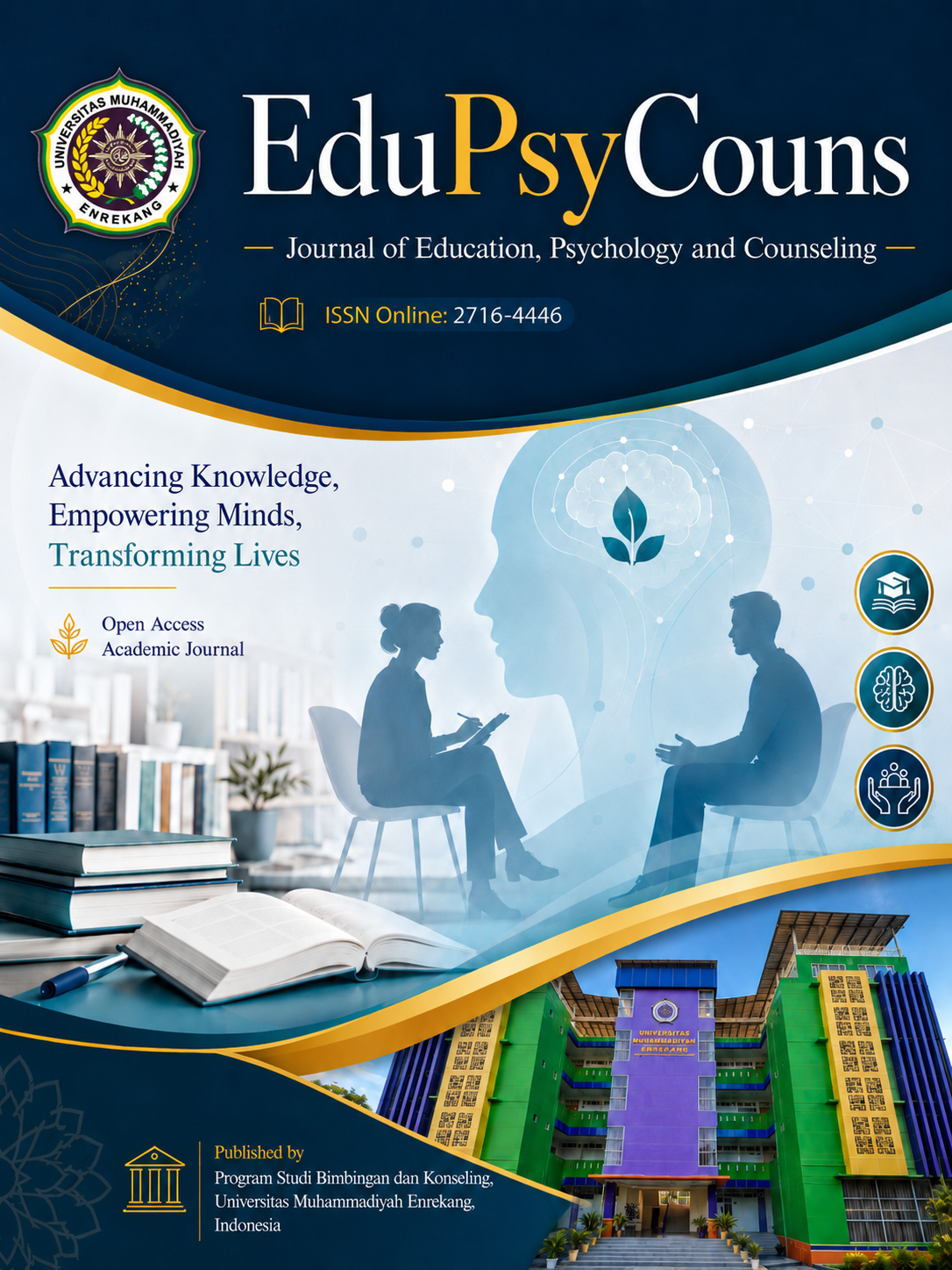
EduPsyCouns: Journal of Education, Psychology and Counseling
EduPsyCouns: Journal of Education, Psychology and Counseling applies editorial policies to ensure the quality, originality, transparency, fairness, and ethical integrity of scholarly publications in education, psychology, guidance, and counseling. These policies guide authors, editors, reviewers, and readers in understanding the journal’s publication standards and editorial procedures.
| Focus and Scope | Section Policies |
| Peer Review Process | Publication Frequency |
| Open Access Policy | Copyright and License |
| Archiving | Plagiarism Policy |
| Publication Ethics | AI Policy |
EduPsyCouns publishes scholarly works in education, psychology, guidance, and counseling. The journal welcomes manuscripts that contribute to the development of educational theory, psychological understanding, counseling practice, school guidance programs, mental health support, learner development, educational innovation, and interdisciplinary studies related to human development.
The journal’s scope includes educational psychology, school counseling, academic guidance, personal guidance, social guidance, career counseling, family counseling, spiritual counseling, multicultural counseling, psychological counseling, social-emotional learning, inclusive education, mental health literacy, digital counseling, educational technology, and related contemporary issues.
Manuscripts outside the areas of education, psychology, guidance, counseling, and relevant interdisciplinary fields may be declined during the initial editorial screening.
EduPsyCouns accepts several manuscript categories that are relevant to the journal’s focus and scope. Each section is subject to editorial screening, peer review, ethical assessment, and formatting requirements.
| Section | Open Submission | Indexed | Peer Reviewed |
|---|---|---|---|
| Research Articles | Yes | Yes | Yes |
| Review Articles | Yes | Yes | Yes |
| Conceptual Papers | Yes | Yes | Yes |
| Case Studies and Practice Reports | Yes | Yes | Yes |
All manuscripts submitted to EduPsyCouns are subject to an editorial screening and peer-review process. The initial screening evaluates the manuscript’s relevance to the focus and scope, completeness of article components, conformity with author guidelines, originality, language quality, and ethical compliance.
Manuscripts that pass the initial screening are sent to reviewers with relevant expertise. Reviewers evaluate the manuscript based on originality, scholarly contribution, methodological clarity, theoretical grounding, discussion quality, ethical standards, citation accuracy, and writing coherence.
Editorial decisions may include: accept submission, revisions required, resubmit for review, or decline submission.
EduPsyCouns: Journal of Education, Psychology and Counseling is published twice a year, in June and December.
The journal may publish articles online after completion of the editorial, peer-review, revision, copyediting, and layout editing stages according to the publication schedule and editorial workflow.
EduPsyCouns: Journal of Education, Psychology and Counseling is an open access journal. All articles published in the journal are freely available to readers without subscription fees, access restrictions, or institutional barriers.
Readers are permitted to read, download, copy, distribute, print, search, link to the full text, and use published articles for academic, research, educational, and other lawful purposes, provided that proper acknowledgment is given to the original source.
This open access policy reflects the journal’s commitment to supporting the dissemination of scholarly knowledge in education, psychology, guidance, and counseling. By providing immediate access to published works, the journal aims to strengthen academic communication, research visibility, and the wider use of scientific findings for educational and social development.
License: This work is licensed under a Creative Commons Attribution 4.0 International License.

Articles may be shared and reused with proper citation to the author(s), article title, journal name, and publication source.
Authors retain the copyright of their published works while granting EduPsyCouns: Journal of Education, Psychology and Counseling the right of first publication. Authors also grant the journal the right to disseminate the article through the official journal website, indexing services, repositories, and scholarly metadata platforms.
Articles published in EduPsyCouns may be read, downloaded, copied, distributed, printed, searched, cited, and used for academic, research, educational, and other lawful purposes, provided that the original author(s), article title, journal name, volume, issue, page, DOI or URL, and publication source are properly acknowledged.
License: Creative Commons Attribution 4.0 International License.
This work is licensed under a Creative Commons Attribution 4.0 International License.
Creative Commons Attribution 4.0 International License
Authors are responsible for ensuring that all copyrighted materials used in the manuscript, including images, figures, tables, instruments, and extended quotations, have been properly cited or permitted by the copyright holder.
EduPsyCouns supports the preservation and long-term accessibility of published scholarly works. The journal maintains digital article records through its official online journal system and supports archiving practices that ensure published articles remain accessible to authors, readers, institutions, and indexing services.
The journal encourages authors to share published article metadata and links through institutional repositories, academic profiles, and scholarly platforms, provided that proper citation and the official publication source are acknowledged.
EduPsyCouns upholds a strict policy against plagiarism, self-plagiarism, duplicate publication, data fabrication, data falsification, citation manipulation, and unethical authorship practices. All manuscripts may be screened using plagiarism detection tools before being sent to reviewers or before final publication.
Authors must ensure that all ideas, quotations, paraphrases, data, images, tables, instruments, and other materials taken from previous works are properly cited. Manuscripts with excessive similarity, poor paraphrasing, missing citation, or indications of plagiarism may be returned to authors, rejected, or subject to further editorial investigation.
Similarity threshold: The journal may consider a manuscript unsuitable for review or publication if the similarity score is excessive or if plagiarism is detected in any part of the manuscript.
EduPsyCouns is committed to ethical publication practices involving authors, editors, reviewers, and publishers. The journal promotes fairness, transparency, confidentiality, accountability, academic integrity, and respect for intellectual property.
Authors, reviewers, and editors must disclose any actual, potential, or perceived conflict of interest that may influence the research, review, or editorial decision-making process. Conflicts of interest may include financial relationships, institutional affiliations, personal relationships, academic rivalry, funding interests, or professional obligations.
When a conflict of interest exists, the editorial team may assign another editor or reviewer to ensure fairness, independence, and transparency in the editorial process.
EduPsyCouns may issue corrections when errors are found in published articles but the main findings remain valid. Corrections may include errors in author names, affiliations, data presentation, references, figures, tables, or other publication details.
Retraction may be considered when a published article contains serious ethical violations, plagiarism, data fabrication, duplicate publication, invalid findings, or other substantial problems that undermine the integrity of the publication.
Authors who wish to withdraw a manuscript must submit a formal request to the editorial office. Withdrawal after peer review, acceptance, or production may be subject to editorial consideration because resources have already been used in the publication process.
Authors may use artificial intelligence tools only to support language editing, grammar checking, translation assistance, reference formatting, or other non-substantive editorial improvements. AI tools must not replace the authors’ intellectual contribution, critical analysis, interpretation of data, ethical responsibility, or scholarly judgment.
AI-generated content must be carefully reviewed, validated, revised, and approved by the authors. Authors remain fully responsible for the accuracy, originality, validity, and ethical integrity of all content in the manuscript.
AI tools cannot be listed as authors or co-authors. Authorship is limited to human contributors who meet the criteria of scholarly contribution and responsibility.
Suggested declaration: During the preparation of this manuscript, the author(s) used [name of tool/service] for [purpose]. After using this tool, the author(s) reviewed, revised, and approved the content and take full responsibility for the final manuscript.
The use of AI tools for data fabrication, false citation generation, manipulation of findings, plagiarism, or deceptive authorship is strictly prohibited.

EduPsyCouns: Journal of Education, Psychology and CounselingOpen Access journal in education, psychology, guidance, counseling, and educational counseling practices, published by Program Studi Bimbingan dan Konseling, Universitas Muhammadiyah Enrekang. |
JOURNAL INFORMATION ISSN Online: 2716-4446 |
ABOUT JOURNAL |
AUTHOR MENUMake a Submission |
JOURNAL POLICIESPublication Ethics |
WEBSITE MIGRATIONPrevious Website: |
 |
License This work is licensed under a Creative Commons Attribution 4.0 International License. |
|
© EduPsyCouns: Journal of Education, Psychology and Counseling. |
Developed and designed by Dr. Ismail, M.Pd. |